 Ultimate guide
7 Precision Machining Facts for Heavy Equipment Owners
Last Updated: October 30, 2026
Quick Summary
Precision machining for heavy equipment keeps hydraulic components within tolerances measured in thousandths of an inch, so bores, rods and seal surfaces survive real working conditions. It covers turning, milling and grinding of shafts, pins, bushings and cylinder rods, plus repair and custom manufacturing of worn or discontinued parts. A shop should state the tolerance it will hold and provide an inspection report with measured values.
- Turning handles round parts like shafts, pins, bushings and cylinder rods; milling handles flats, keyways and bolt patterns.
- Hydraulic rod surface finish typically targets 4 to 16 microinch Ra, while cylinder bores run 16 to 63 microinch Ra.
- Straighten a bent shaft before grinding, or the same wear pattern will be reproduced.
- Case-hardening hardens only the surface for cylinder rods and gear teeth while leaving a tough core.
- Ask for an inspection report with measured bore, roundness, straightness and finish values, not a pass/fail stamp.
Table of Contents
- Why Precision Machining Decides Whether Heavy Equipment Stays Running
- CNC Machining and the Core Methods Behind Heavy-Duty Work
- Precision Tolerance Requirements for Hydraulics
- Hydraulic Cylinder Repair Services That Restore Dimensional Accuracy
- Custom Hydraulic Component Manufacturing for Obsolete and Hard-to-Find Parts
- Material Selection, Heat Treatment and Surface Finish
- How to Vet a Machine Shop Before You Send a Component
- Get a Quote on Precision Machining for Your Equipment
- Frequently Asked Questions
Why Precision Machining Decides Whether Heavy Equipment Stays Running
A hydraulic cylinder that drifts a few thousandths of an inch out of tolerance doesn't fail politely. It scores a rod, chews through seals, and takes a loader or breaker out of service for days.
At Brothers Hydraulics LLC, we've built our shop around that reality since 2013. The global precision machining market was estimated at USD 124.41 billion in 2026 and is projected to reach USD 244.6 billion by 2035, according to Business Research Insights' market forecast, which tells you how much industry now depends on tight-tolerance metalwork.
CNC Machining and the Core Methods Behind Heavy-Duty Work
Three operations do most of the work, and each handles a different geometry:
Turning, Milling and Grinding: What Each Operation Handles
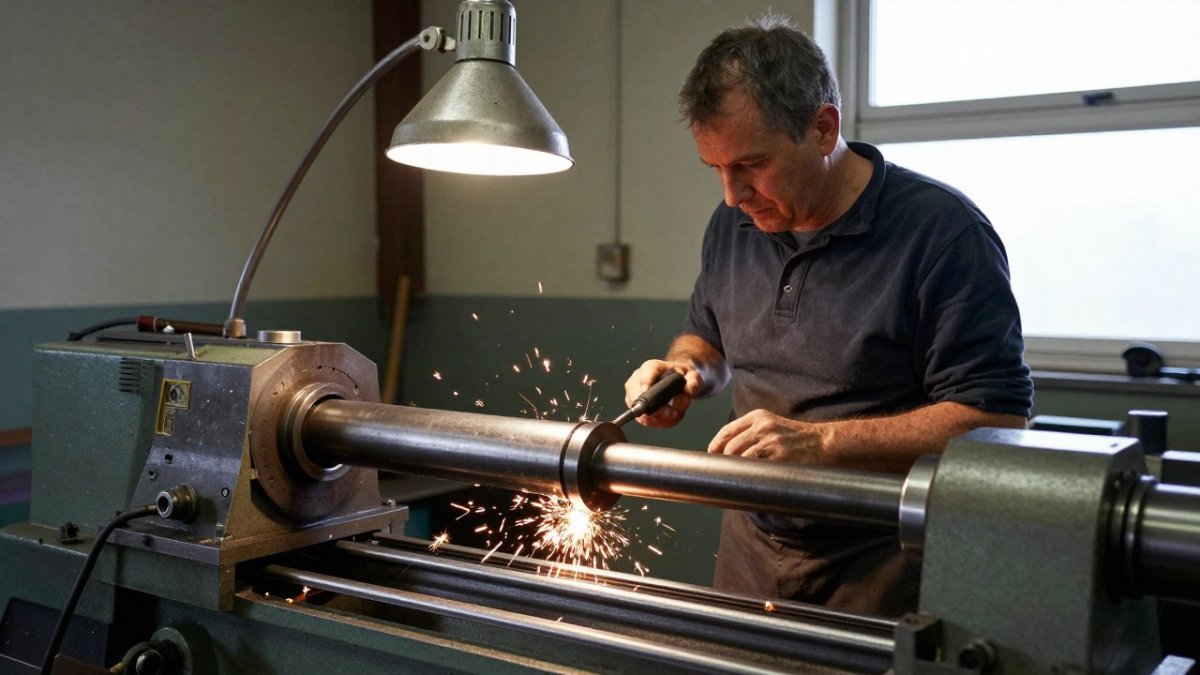
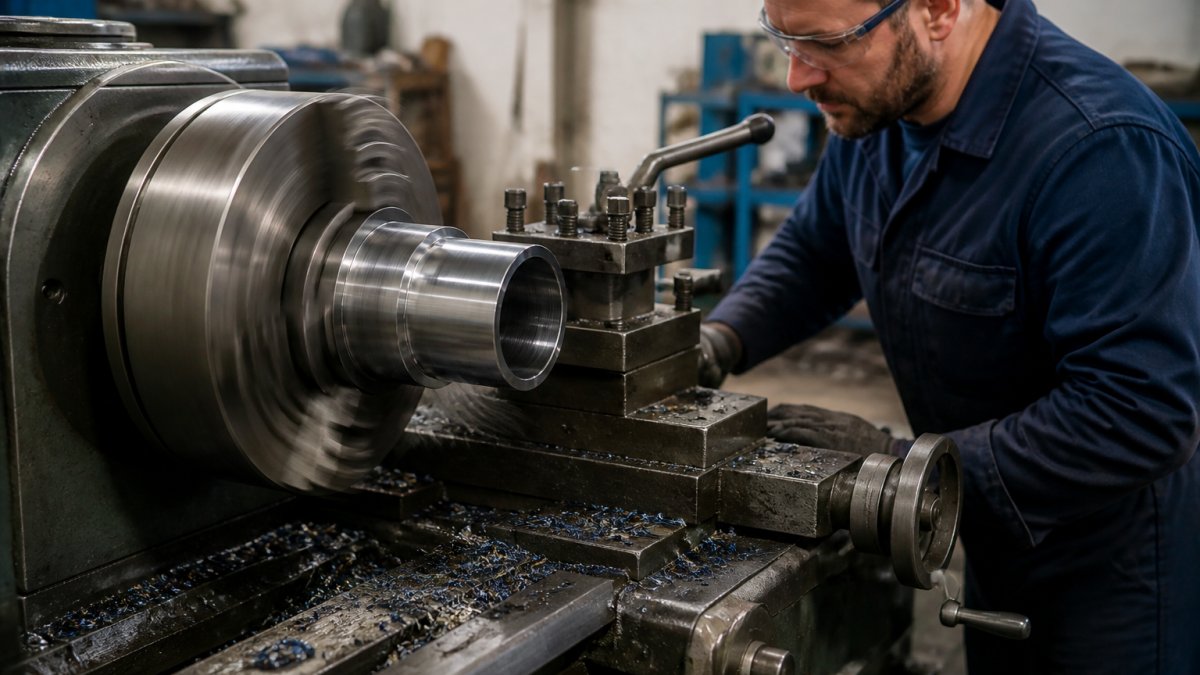
- Turning spins the workpiece against a fixed cutting tool. It's the operation for shafts, pins, bushings, and cylinder rods, anything round that needs a consistent diameter.
- Milling moves a rotating cutter across a stationary part. It handles flats, keyways, bolt patterns, mounting faces, and pockets in housings and adapters.
- Grinding removes tiny amounts of material with an abrasive wheel to hit the finest tolerances and surface finishes, typically after turning or heat treatment has moved the part.
A common mistake is sending a scored rod straight to grinding without checking whether the underlying shaft is bent. Straighten first, then grind, or you'll reproduce the same wear pattern.
Five-Axis, Gantry and Vertical Lathe Work for Large Components
Oversized workpieces need machines built for them. A vertical lathe holds a large, heavy part flat on a rotating table, suiting gear cases, flywheels, and large flanges that would sag on a horizontal spindle. Gantry machining puts the cutting head on a bridge over a fixed bed, so an engine block or multi-foot weldment can be machined without repositioning.
Workholding is where large-part machining gets hard. A part that shifts 0.002 inches under cutting load is scrap, no matter how good the machine is.
Our in-house machine shop handles custom hydraulic component manufacturing.
Precision Tolerance Requirements for Hydraulics
Hydraulic components live and die by clearance.
Research indexed by ScienceDirect on machine tool service life identifies precision retention and reliability of CNC machine tools as direct indicators of machining quality and production efficiency.
Three measurements decide whether a hydraulic repair holds:
| Measurement | What It Governs | Why It Matters |
|---|---|---|
| Bore diameter and roundness | Piston-to-bore clearance | Out-of-round bores leak past new seals |
| Rod diameter and straightness | Seal lip contact | A bent rod destroys seals in weeks |
| Surface finish (Ra) | Seal and bearing life | Too rough tears seals; too smooth won't hold oil film |
If a rod is scored, bent, or worn below spec, replacement or rebuild is usually faster than trying to save it. We also handle shaft and hydraulic rod repair.
Hydraulic Cylinder Repair Services That Restore Dimensional Accuracy
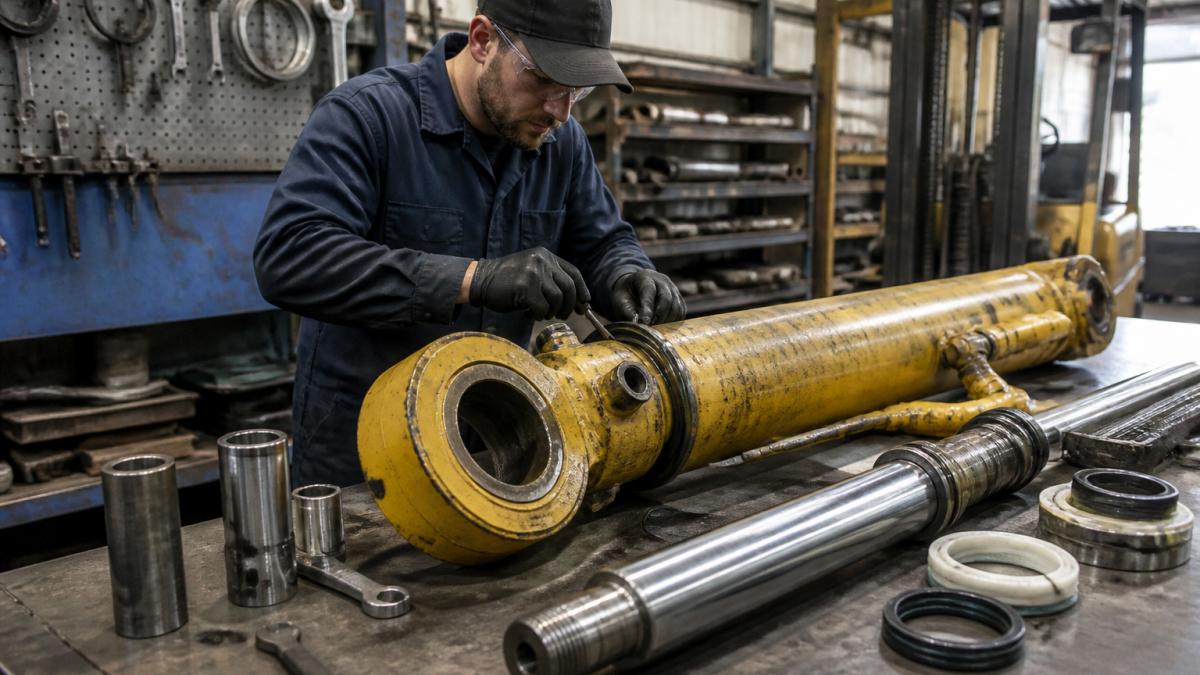
Hydraulic cylinder repair services restore a worn or damaged cylinder to its original dimensional specifications rather than patching it to get by.
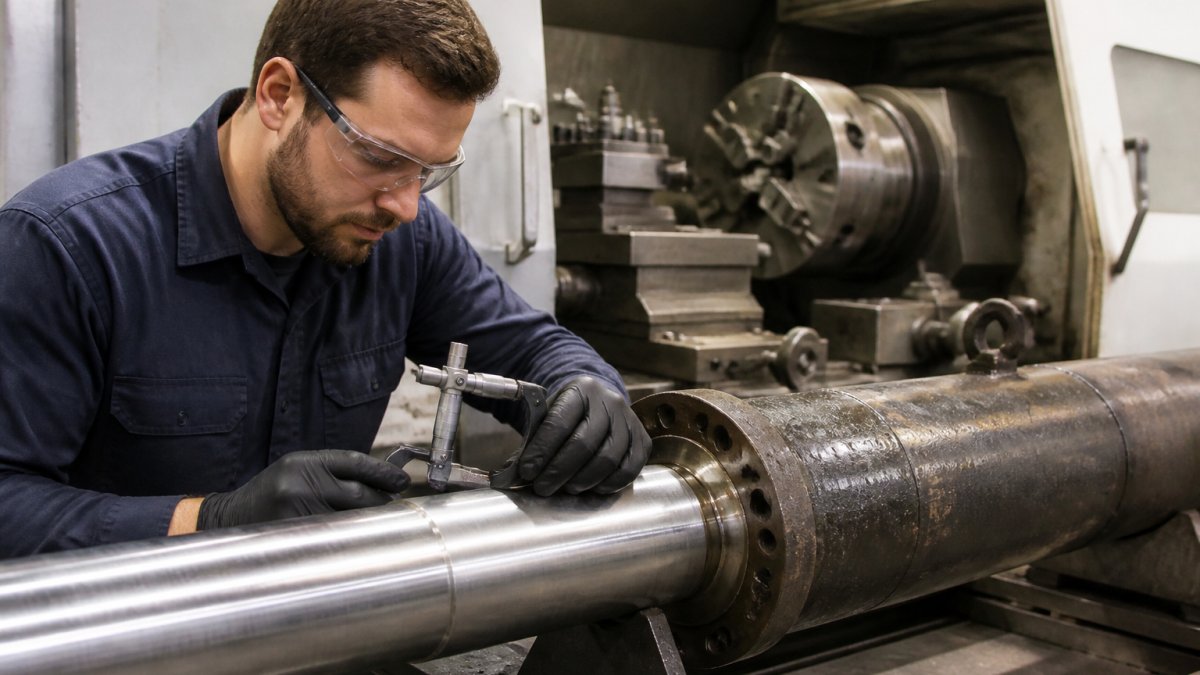
The order of operations matters. Replacing seals on a cylinder with a scored rod does not fix the underlying problem. We measure first, then decide what gets machined, rechromed, or replaced.
Our hydraulic cylinder repair services cover construction, agricultural, industrial, and transportation equipment. Turnaround matters when a machine is down.
Custom Hydraulic Component Manufacturing for Obsolete and Hard-to-Find Parts
Custom hydraulic component manufacturing is the production of a replacement part from dimensions or a sample when no catalog number exists. Older equipment is where this matters most: a machine that's been in service 15 or 20 years often has a cylinder gland, piston, or rod end that the original manufacturer discontinued years ago.
Reverse-engineering a part starts with measurement, not guesswork.
Material Selection, Heat Treatment and Surface Finish
Material choice drives how a component wears, how it fails, and what it costs to keep running. For heavy equipment, the right alloy and heat treatment depend on the load, the environment, and the mating surface, not on what's cheapest per pound.
Matching Alloys to Component Duty
A few common pairings show how the logic works:
- **
- **
- **
- **
What Heat Treatment Actually Changes
Heat treatment alters the steel's microstructure after machining, and the wrong choice can leave a part brittle where it needs to flex or soft where it needs to resist wear.
- Through-hardening raises hardness uniformly through the section. It suits pins and shafts where wear occurs across the full diameter, but requires enough hardenability, 4140 and 4340 respond well; plain carbon steels like 1045 need a fast quench and may not harden deeply in large sections.
- Case-hardening (carburizing or induction) hardens only the surface while leaving a tough core. It's standard for cylinder rods and gear teeth, where a hard wear surface must sit on a core that absorbs shock without cracking.
- Stress relief is performed after welding or rough machining to relieve residual stresses that would otherwise move a part during finish machining or in service. Large weldments almost always need it before final cuts.
Surface Finish: The Number That Decides Seal Life
Surface finish is measured as Ra (arithmetic average roughness) in microinches or micrometers. For hydraulic rods, a typical target is 4-16 microinch Ra (about 0.1-0.4 micrometer) with a plunge-ground or superfinished profile; too rough tears the seal lip, while a purely isotropic finish that's too smooth can fail to retain an oil film.
The practical point: specify the finish on the drawing, and ask the shop how it will measure it. A profilometer reading on the actual part is the only proof.
A ScienceDirect case study on machining process evaluation traces the sequence from part evaluation and cutting-strategy selection through machining and process review, which mirrors the discipline a good shop applies when it selects material and treatment for a repair rather than defaulting to the original spec.
How to Vet a Machine Shop Before You Send a Component
Most buyers pick a machine shop on price and turnaround, then discover the gaps after the part is late or out of tolerance. A structured evaluation up front costs an hour and saves weeks.
1. Capability and Capacity
Ask for the machine envelope, maximum swing, length, weight, and the tolerances the shop can hold on that size. A shop with a 40-inch lathe cannot swing a 60-inch flywheel, and a shop that says "we can handle anything" without numbers is guessing. For large work, ask how they handle workholding and parts that may shift under cutting load.
Verify capacity against your part, not a brochure. If the part weighs 2,000 pounds, confirm the crane and fixturing can handle it.
2. Inspection and Quality Documentation
Ask what measurement equipment the shop uses, micrometers, bore gauges, profilometers, and a coordinate measuring machine (CMM) if geometry is complex, and whether they provide an inspection report with the part.
If your industry requires traceability, ask whether the shop works to a recognized quality standard. Many job shops operate without formal certification, acceptable for repair work but possibly not for a regulated buyer. Be clear about what you need before the job starts.
3. Quote Transparency
A quote should itemize machining, any straightening, rechroming, heat treatment, and secondary operations. The cheapest hourly rate is meaningless if the quote excludes rechroming or setup. Ask for the total delivered price and the assumptions behind it, what happens if the part needs more weld buildup than expected, or if the bore is found cracked after disassembly.
4. Communication and Turnaround
Ask who your point of contact is, how often you'll get status updates, and what the shop does when a part reveals a problem mid-repair. A shop that calls before proceeding on a scope change is worth more than one that quietly does the work and bills it. Get the turnaround in writing and ask what happens if the shop misses it.
5. Repair Versus Replace
A good shop will tell you when a part is not worth repairing. Ask for their threshold, for example, whether a rod worn below a certain diameter or a bore with deep scoring is a candidate for repair or replacement.
Use this checklist before you commit:
- Can they state the tolerance they'll hold, in numbers, for your specific part size?
- Do they have the machine capacity for your part's size and weight, verified against the actual envelope?
- Will they provide an inspection report with the measured values, not just a pass/fail stamp?
- Will they quote the full job, machining, straightening, rechroming, heat treatment, or bill surprises later?
- Can they source or manufacture a discontinued component?
- Do they explain what failed and why, or just hand back a repaired part?
- What's their stated turnaround, and what happens if they miss it?
- Will they tell you when a part is not worth repairing?
Get a Quote on Precision Machining for Your Equipment
The hard part isn't finding a shop that can run a lathe.
Brothers Hydraulics LLC has provided hydraulic cylinder repair and precision machining since 2013, with custom parts manufactured to specification and fast turnaround on construction, agricultural, industrial, and transportation equipment.
You can call or text us, or send photos of your cylinder or part and we'll tell you what it needs. Get started with Brothers Hydraulics LLC and get your equipment back to work.
Frequently Asked Questions
What tolerances are required for heavy equipment hydraulic components?
Hydraulic cylinder bores, rods and seal surfaces usually need to hold tolerances in the thousandths of an inch, with surface finish specified in microinches, because clearance and finish drive seal life and leakage. The precision tolerance requirements for hydraulics vary by component: a rod may need a tighter straightness and roundness callout than a mounting bracket. Always machine to the OEM drawing or an engineered equivalent.
When should you choose custom machining over OEM replacement parts?
Custom machining makes sense when the OEM part is discontinued, lead times stretch past your downtime budget, or a design change would prevent repeat failures. It also fits low-volume or legacy equipment where tooling for a new casting is not justified. Precision machining a replacement from bar stock or a billet can match original dimensions and materials. Ask the shop for the drawing, material certification and inspection report so you can verify fit before installation.
What materials are most commonly used in heavy equipment precision machining?
Carbon and alloy steels dominate rods, pins and shafts, with chrome plating or induction hardening on wear surfaces. Cast iron and ductile iron show up in housings and gear cases, aluminum in lighter brackets, and brass or bronze in bushings and wear rings. Material choice affects machinability, heat treatment and corrosion resistance, so match the spec to the application.
How does precision machining extend the operational life of mining machinery?
Mining equipment runs in abrasive, high-load conditions where small dimensional errors accelerate wear. Holding tight tolerances on bores, rod journals and seal grooves keeps clearances correct, which reduces fluid bypass and heat. Proper surface finish on sealing surfaces limits seal abrasion. When a component is remachined or replaced to spec, the assembly returns to its designed load path, so the next failure is less likely to arrive early. Pair machining with contamination control for the best result.