 How-to
What Does Hydraulic Repair Shop Pricing Cost in 2026?
Last Updated: October 26, 2026
Quick Summary
Hydraulic repair shop pricing in 2026 runs from roughly $250 to $600 for seal replacement and $1,200 to $3,000 or more for a complete rebuild, according to PSI Hydraulics' 2026 repair pricing guide. The final number depends on cylinder size, rod and barrel damage, and parts availability. Quotes should separate labor, parts, and machining so there are no surprise charges after teardown.
- Labor typically runs $85 to $175 per hour, while seal kits cost $40 to $350.
- Rod rechroming adds $250 to $900 and barrel honing adds $200 to $750 to a job.
- A reseal plus rod rechroming and honing commonly lands in the $900 to $1,800 range.
- Shop rebuilds carry lower labor rates, often $85 to $150 per hour, than field service.
- Send photos of the cylinder, rod, and leak point to get a quote before hauling anything in.
Table of Contents
- What Hydraulic Repair Shop Pricing Looks Like in 2026
- Hydraulic Cylinder Rebuild Cost: What Drives the Number
- Your Hydraulic Repair Estimate Checklist
- Hydraulic Cylinder Repair Turnaround Time, Start to Finish
- Hydraulic Cylinder Repair vs Replacement: Where the Break-Even Sits
- Shop Rebuild vs Field Service: Which Costs Less for Your Equipment
- Get a Quote for Hydraulic Repair Shop Pricing
- Frequently Asked Questions
What Hydraulic Repair Shop Pricing Looks Like in 2026
Hydraulic repair shop pricing in 2026 runs from roughly $250 to $600 for seal replacement and $1,200 to $3,000 or more for a complete rebuild, according to PSI Hydraulics' 2026 repair pricing guide.
That spread is wider than most buyers expect. It is also the reason two shops can quote the same cylinder and land $1,500 apart.
Hydraulic repair shop pricing is the total cost of restoring a hydraulic component, combining labor, parts, machining, and testing. It is not a single hourly rate.
Three forces set the number:
- What failed. A worn seal is a small job. A scored rod or cracked barrel is not.
- Parts availability. In one 2026 survey, 20.6% of repair shops named finding affordable parts as a challenge and 17.7% named finding the needed parts at all, per IMR Automotive Research's 2026 Repair Shop Challenges survey.
- Shop versus field. Mobile work carries travel and setup costs that a bench rebuild does not.
The market reflects that demand. Business Research Insights values hydraulic component repair services at USD 1.23 billion in 2026, forecast to reach USD 2.48 billion by 2035.
Hydraulic Cylinder Rebuild Cost: What Drives the Number
A hydraulic cylinder rebuild cost is driven by five line items: labor hours, seal kits, machining or rechroming of the rod, barrel honing, and testing. Each one scales with cylinder size, and each one has a realistic 2026 range you can use to sanity-check a quote before you approve it.
Diesel Works' 2026 repair cost guide puts most bucket-truck hydraulic work at $150 to $4,500, with hose replacement at the low end and cylinder reseal or rebuild at $400 to $3,000. Those are vehicle-specific figures, not a universal shop rate.
| Cost Driver | Typical 2026 Range (USD) | What It Covers | Impact on Price |
|---|---|---|---|
| Labor hours | $85-$175 per hour | Disassembly, cleaning, inspection, reassembly | Moderate |
| Seal kit | $40-$350 | New seals, wipers, O-rings, backup rings | Low to moderate |
| Rod rechroming | $250-$900 | Stripping, grinding, hard-chrome plating, polishing | High |
| Rod straightening or welding | $150-$600 | Press straightening, weld build-up, remachining | Moderate to high |
| Barrel honing | $200-$750 | Removing scores and ovality, restoring bore | Moderate to high |
| Testing | $75-$250 | Pressure and leak verification after assembly | Low |
A straightforward reseal on a small cylinder, new seals, no rod or barrel work, commonly lands in the $250 to $600 band. Add rod rechroming and barrel honing and the same cylinder moves into the $900 to $1,800 range.
Here is how the drivers stack up in practice:
- Labor hours. A small cylinder may come apart and go back together in two to four hours. A large-bore or heavily corroded unit can take eight to sixteen. At a $120 hourly rate, that spread alone is roughly $240 to $1,900.
- Seal kit. Standard kits are inexpensive; proprietary or discontinued kits can cost several times more and may carry lead times.
- Rod repair. This is where budgets move. Rechroming a scored rod is often cheaper than a new rod, but a bent rod that needs straightening plus rechroming can approach the price of replacement.
- Barrel honing. Deep scores or ovality require boring and honing, and in severe cases a sleeve. That pushes the job toward the top of the rebuild band.
- Testing. Skipping it is a false economy. A pressure test after assembly is what catches a leaking gland before the cylinder goes back on the machine.
A common mistake is comparing quotes on the seal kit alone. The rod and barrel condition is where the real money sits. If you want to see what a full rebuild includes before you judge a quote, Brothers Hydraulics LLC provides reliable hydraulic repair and precision machining services.
Your Hydraulic Repair Estimate Checklist
A hydraulic repair estimate checklist keeps quotes comparable. Ask every shop the same questions and score the answers side by side.
- Does the quote separate labor, parts, and machining?
- Is rod rechroming included or billed separately?
- What is the stated turnaround, in business days?
- Is testing after assembly included?
- Are hard-to-find or discontinued parts sourced, or is that extra?
- What warranty covers the work, and for how long?
- Is travel or field setup charged separately?
- Are there charges if the cylinder is beyond repair?
Most hidden-fee complaints trace back to one of these. A shop that quotes an hourly labor rate without naming machining charges has not given you a price. It has given you an opening bid.
Before you commit, compare the estimate against the full scope of hydraulic cylinder repair services so you know which line items should be there.
Hydraulic Cylinder Repair Turnaround Time, Start to Finish
Typical hydraulic cylinder repair turnaround time runs from a few business days for a straightforward reseal to two weeks or more when rod machining or hard-to-find parts are involved. Parts sourcing is usually the longest step.
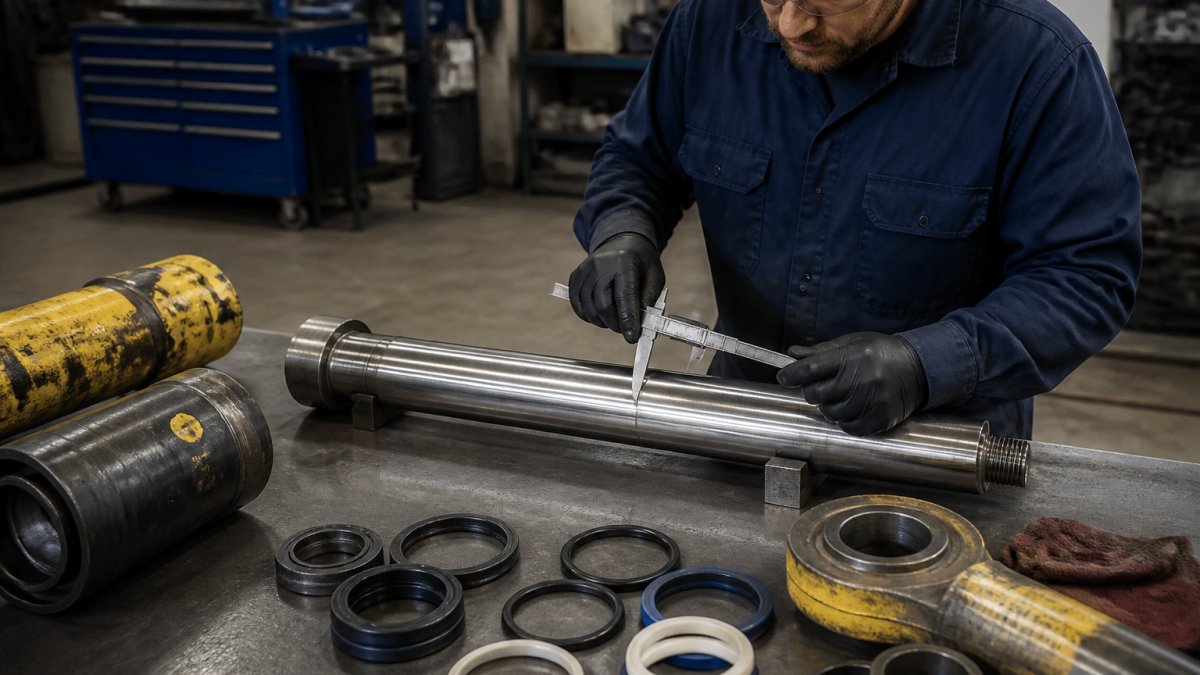
The sequence is consistent across most shops:
- Teardown and inspection. The cylinder is opened and the failure is identified.
- Quote approval. Findings become a firm estimate.
- Parts and machining. Seals are ordered; rods are straightened, welded, or rechromed.
- Reassembly and testing. The unit is rebuilt and pressure-checked.
- Return or refit. Bench delivery or field installation.
Steps 3 and 5 are where schedules slip. For a deeper breakdown of turnaround times to plan downtime around the repair, see hydraulic cylinder repair turnaround time. Ask which step your job is in, not how many days are left.
Hydraulic Cylinder Repair vs Replacement: Where the Break-Even Sits
Repair usually wins when the barrel and rod are sound and the failure is seals or wear. Replacement wins when the barrel is cracked, the rod is bent beyond straightening, or the cylinder is obsolete and a new unit is unavailable.
The break-even is not a percentage. It is a condition test. Run it in this order:
- Barrel sound? Cracks or deep scores push toward replacement.
- Rod repairable? Bent, worn, or scored rods can often be repaired rather than replaced, which shifts the math back toward repair.
- Parts available? If the seal kit or rod exists, repair stays viable.
- Downtime cost? A faster repair often beats a cheaper replacement that arrives weeks later.
That third point matters more in 2026 than it used to. With parts sourcing already a reported constraint for shops, a rebuild that uses repairable components avoids the supply chain entirely.
Shop Rebuild vs Field Service: Which Costs Less for Your Equipment
A shop rebuild costs less per hour of labor. Field service costs less per hour of downtime. Which one wins depends on whether the machine can move, how far the technician has to travel, and what an hour of downtime actually costs you.
Bench work gives the technician full tooling, a press, and testing equipment. That usually means a more thorough job and a lower labor rate.
| Factor | Shop Rebuild | Field Service |
|---|---|---|
| Labor rate | Lower, often $85-$150 per hour | Higher, often $125-$225 per hour |
| Travel charges | None | Commonly $75-$250 per trip, plus mileage beyond a local radius |
| Transport of the cylinder | Your cost to haul in and back | None |
| Tooling access | Full bench, press, hone, test stand | Limited to mobile kit |
| Best for | Removable cylinders | Equipment that cannot move |
| Testing | Full pressure test on a test stand | On-site verification, less thorough |
| Turnaround | Depends on shop queue and parts | Often faster for simple jobs |
A simple way to compare the two is to put a dollar value on downtime.
For equipment that is down and blocking a job, field diagnostics often pay for themselves in recovered hours. For a cylinder that comes off quickly and can be hauled, the bench gives you better tooling and a lower rate. The mistake is defaulting to one or the other without pricing the downtime.
Get a Quote for Hydraulic Repair Shop Pricing
Accurate hydraulic repair shop pricing starts with photos. Send clear images of the cylinder, the rod, and the leak point, plus the machine make and model.
Brothers Hydraulics LLC has provided expert hydraulic cylinder repair and precision machining services tailored for construction, agriculture, industrial, and transportation equipment since 2013. We manufacture hard-to-find and discontinued components, which helps reduce parts-availability delays.
Get a Quote by calling or texting us at (602) 675-1710 with photos of your cylinder or part. We are open Monday through Friday, 7:30 AM to 4:00 PM.
Frequently Asked Questions
How much does it cost to get a hydraulic cylinder rebuilt in 2026?
Seal replacement typically runs $250 to $600, while a complete rebuild can reach $1,200 to $3,000 or more, according to PSI Hydraulics. The final figure depends on cylinder size and whether the rod or barrel is damaged. A scored rod needs rechroming or replacement, which pushes the job toward the top of that range. Ask for the quote to separate parts, machining, and labor so you can see exactly what is driving the total.
What factors affect a hydraulic repair shop's estimate?
Five things move the number most: the failed component, the condition of the rod and barrel, parts availability, labor hours, and whether the work happens in the shop or on site. In a 2026 IMR Automotive Research survey, 20.6% of shops named finding affordable parts as a challenge and 17.7% named finding needed parts, so obsolete or discontinued components add cost and lead time. Fluid contamination and hidden wear found during inspection can also expand the scope after the initial quote.
Is it cheaper to repair or replace a hydraulic cylinder?
Repair usually wins when the barrel and rod are sound and only seals or a hose failed. Replacement makes more sense when the barrel is deeply scored, the rod is bent, or the cylinder is a discontinued model with no parts supply. Use the rebuild cost as your benchmark: if a rebuild lands well below the price of a comparable new cylinder and the rest of the machine has service life left, rebuild. Get both numbers before you decide.
How long does hydraulic cylinder repair usually take?
Simple reseals often turn around in a few days, while full rebuilds with machining or rechroming take longer, especially when parts must be sourced. Turnaround time depends on parts availability and shop backlog more than the repair itself. Ask for a committed date in writing and confirm whether the shop manufactures hard-to-find components, since that helps reduce the wait on outside suppliers. On-site diagnosis can shorten the front end by catching the failure before hauling.
Hydraulic downtime is measured in lost production, not in invoice lines. Get a quote from Brothers Hydraulics LLC with photos of your cylinder, and we will scope the repair, flag any machining the estimate needs, and give you a turnaround you can plan around.