 How-to
Hydraulic Repair Shop Labor Rates: What to Expect
Last Updated: November 17, 2026
Quick Summary
Hydraulic repair shop labor rates typically fall between $75 and $200 per hour, depending on the repair type, equipment class and region. Most heavy-duty shops charge $120 to $175 per hour, and hydraulic work often lands near the upper end because it needs test equipment and pressure-related expertise.
- Most heavy-duty shops charge between $120 and $175 per hour, per a truck-repair guide.
- Field-service rates are higher than shop rates because they include the technician's travel time.
- Hose repair bands run about $75 to $150 per hour, while pump and motor repair runs $110 to $200.
- Ask whether a diagnostic fee is credited toward the repair if you approve the work.
- Request a written estimate that breaks out each labor line, including testing and minimum charges.
Table of Contents
- Shop Labor Rate Versus Field-Service Rate
- Hourly Labor Rate Benchmarks for Hydraulic Repair
- Hydraulic Cylinder Repair Cost: How Labor Adds Up
- Hydraulic Repair Labor Hours: Diagnosis, Teardown and Reassembly
- Reading a Hydraulic Repair Estimate Line by Line
- Factors That Raise or Lower Hydraulic Labor Rates
- Requesting Your Hydraulic Repair Quote From Brothers Hydraulics LLC
- Frequently Asked Questions
Hydraulic repair shop labor rates are the hourly price a shop charges for technician time, and they make up a large share of most repair invoices. Customers often compare quotes without knowing what sits behind each number. Most shops start from a simple formula: the labor rate covers wages, insurance, tools, facility costs and a margin, all spread across billable hours. Published national benchmarks give a useful starting point, though they are not hydraulic-specific. AAA reports that most mechanics charge $120 to $159 per hour, with rates ranging from under $100 to over $200 AAA automotive repair benchmark report. Heavy-duty shops show a similar spread. A truck-repair guide puts most shops between $120 and $175 per hour Skyline Repair Center heavy-vehicle repair rate comparison.
Shop Labor Rate Versus Field-Service Rate
A shop labor rate applies when the equipment comes to the bench. A field-service rate applies when a technician travels to the machine. Field work costs more because the technician's time includes the drive, and the shop must cover the vehicle, fuel and tools needed on site. Expect the field rate to be higher, and expect a separate travel or minimum charge on top of it.
Shop Billing Rate Versus Technician Pay
The hourly billing rate and the technician's hourly wage are two different numbers. A technician who earns $35 per hour does not mean the customer pays $35 per hour. Shops bill at a multiple of wages to cover the time technicians spend unbilled, such as training, cleanup and waiting for parts. Ask any shop how many hours it bills per paid hour. That ratio shows how much of the rate is overhead.
Hourly Labor Rate Benchmarks for Hydraulic Repair
No published survey isolates hydraulic repair shop rates, so treat any single number with caution. What a shop charges depends on the repair type, the equipment class and the region. The ranges below are directional shop-rate bands that most independent hydraulic shops fall into for bench work, before travel, parts and testing. Use them to sanity-check a quote, not as a fixed price list.
| Repair type | Typical shop-rate band (per hour) | What drives the spread |
|---|---|---|
| Hydraulic hose repair and replacement | $75 to $150 | Hose size, fitting type, whether the assembly is made on site or in the shop |
| Cylinder reseal and rebuild | $100 to $185 | Bore and rod size, seal kit cost, whether the rod or bore needs machining |
| Pump and motor repair | $110 to $200 | Pump type (gear, vane, piston), tolerances, test-bench time |
| Valve repair and setup | $100 to $190 | Valve complexity, whether flow and pressure testing is included |
| Custom fabrication and hard-line work | $95 to $175 | Tube bending, welding, pressure rating, fit-up time |
| Diagnostic and testing only | $100 to $175 | Whether the shop has a flow-and-pressure test bench |
Typical shop-rate band (per hour)
These bands sit inside the broader heavy-duty range. A truck-repair guide puts most heavy-duty shops between $120 and $175 per hour Skyline Repair Center heavy-vehicle repair rate comparison, and AAA reports most automotive mechanics charge $120 to $159 per hour AAA automotive repair benchmark report. Hydraulic work often lands at the upper end because it needs test equipment, clean-room practices and technicians who understand pressure and contamination.
Fullbay's 2026 heavy-duty repair trends report, as covered by Fleet Equipment, cites a rate of $149, though the basis of that figure is not clear Fleet Equipment coverage of Fullbay heavy-duty repair trends. Mechanical labor rates also rose faster than body and refinish rates. NABR figures cited by Autobody News show mechanical labor rates up 11.6 percent year over year in June Autobody News coverage of NABR labor rate data.
A practical way to read these numbers is to ask whether the quoted rate is a shop rate, a field rate or a flat rate, and whether it includes travel. Compare like with like. A $95 hose rate and a $175 cylinder rate can come from the same shop and both be fair, because the work, tooling and risk are different.
Ask what a low rate leaves out, such as testing, cleanup or warranty coverage, before comparing it to a higher one.
Hydraulic Cylinder Repair Cost: How Labor Adds Up
Labor is often a large part of a cylinder repair bill that does not involve new parts. For the repair service itself, see hydraulic cylinder repair in Phoenix, AZ for leaking, damaged or worn cylinders. The total equals the hours on the job multiplied by the agreed rate, plus any parts, machining and testing. Pricing depends on the cylinder's size, the damage and the work required. Visit the Brothers Hydraulics LLC website for current pricing or a quote. Request a written estimate that breaks out each labor line.
Overtime, After-Hours and Travel Charges
Overtime and after-hours work often carry a premium, and travel charges can add a fixed fee or a per-mile rate. Ask in advance whether a rush job triggers an after-hours surcharge. A minimum charge for a service call is common, so confirm it before the technician rolls out.
Hydraulic Repair Labor Hours: Diagnosis, Teardown and Reassembly
Labor hours fall into three stages. Diagnosis finds the fault, and a good diagnosis prevents paying for parts that are not needed. Teardown removes the cylinder from the machine, disassembles it and inspects the bore and rod. Reassembly installs new seals, runs the cylinder and tests it under pressure. Skipping diagnosis tends to cost more later, because a repeat failure means paying the labor twice. For rebuild details, see our guide on Hydraulic Cylinder Repair Turnaround Time: What to Expect in 2026.
Reading a Hydraulic Repair Estimate Line by Line
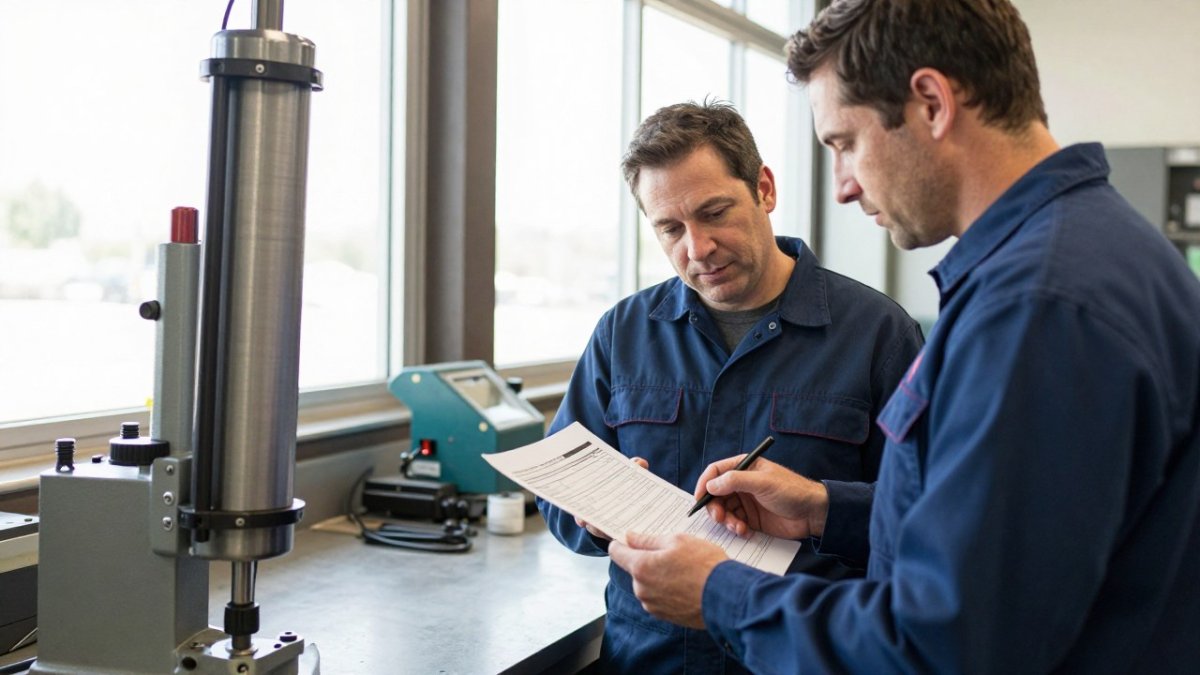
A clear estimate lists each labor task with its hours and rate, then each part with its price, then any fees. The line items below are the ones that most often change the final invoice, and each one deserves a question before you approve the work.
- Diagnosis. A separate diagnostic charge, often one to two hours at the shop rate, pays for finding the fault. Ask whether the diagnostic fee is credited toward the repair if you approve it.
- Teardown and inspection. Removing the cylinder or pump and inspecting the bore, rod and seals is billed as its own labor line. This is where a shop learns whether machining is needed.
- Parts. Seals, hoses, fittings and replacement components are listed separately from labor. Ask whether the shop uses OEM or aftermarket parts and how that affects the warranty.
- Consumables and shop supplies. Solvents, rags, sealant and small hardware are sometimes bundled into a percentage of the labor or parts total. Ask what the percentage covers.
- Testing. Pressure and flow testing after reassembly is labor, and it is the step that catches a bad seal before the unit leaves the shop. Confirm that testing is included rather than optional.
- Freight. Shipping a cylinder or pump out for machining or specialized repair adds freight both ways. Ask who arranges it and whether it is marked up.
- Travel and service-call fees. Field work adds a fixed service-call fee or a per-mile charge on top of the field labor rate. Confirm the minimum charge before a technician rolls out.
- Minimum charges. Many shops bill a one-hour minimum even for a quick hose swap. Ask what the minimum is and whether it applies to bench work as well as field calls.
Check that the hours match the work described. A cylinder reseal that lists two hours of teardown and one hour of reassembly is easier to trust than a single lump-sum labor line. Look for add-ons such as shop supplies, hazardous waste disposal or testing, and ask what each one covers. A line that says only "misc" deserves a question.
Final invoices can differ from the original estimate when machining, freight or a second test run is needed. A shop that explains those possibilities up front is easier to compare than one that quotes a single low number and adds charges later. Request a written estimate that breaks out each labor line, and ask the shop to flag which items are fixed and which are estimates.
Factors That Raise or Lower Hydraulic Labor Rates
Several factors move the rate. Job complexity and risk matter most, since a seized cylinder takes longer than a seal swap. Equipment type matters too: heavy machinery needs lifting gear and larger tooling. Shop location, the technician's certifications and the shop's overhead all shift the rate. Customers who bring equipment in on a regular schedule often get more predictable pricing than one-time callers.
Requesting Your Hydraulic Repair Quote From Brothers Hydraulics LLC
Request a quote through the Brothers Hydraulics LLC website. Ask for a line-item breakdown so you can compare it with other quotes on the same terms.
Brothers Hydraulics LLC has repaired hydraulic cylinders for construction, agricultural, industrial and transportation customers since 2013. Get a clear, itemized estimate from our team and get your equipment back to work.
Frequently Asked Questions
Is $100 an hour fair for mechanic labor?
Whether $100 an hour is fair depends on the type of work and the shop's location. Automotive repair rates vary widely, but those benchmarks do not cover hydraulic work. Hydraulic repair often requires specialized diagnostic equipment and experienced technicians, so rates at the lower end may still be reasonable for simple jobs. Compare the quoted rate with what other qualified shops charge for the same scope of work before deciding.
How much does it cost to fix hydraulics?
Hydraulic repair cost depends on the component, the level of damage and the labor hours required. Labor is usually the largest share of a hydraulic repair estimate, while parts such as seals, hoses or cylinder rods add to the total. Brothers Hydraulics LLC does not publish fixed prices for every repair, so pricing depends on the equipment, the scope of work and the parts required. Request a written quote with an itemized estimate to see how labor and parts are priced before you approve the work.
Does a hydraulic repair estimate include diagnostic time?
A hydraulic repair estimate should list diagnostic time as its own line item if the shop charges for it. Some shops apply diagnostic charges toward the repair if you approve the work, while others bill them separately. Ask whether diagnosis is included, how it is billed, and whether it is credited toward the final invoice. Clear answers to these questions help prevent surprises when the invoice arrives.
How can I compare hydraulic repair quotes?
Compare quotes on the same basis: the labor rate, estimated labor hours, parts list, diagnostic charges, travel or service-call fees and any warranty terms. A lower hourly rate does not always mean a lower total if the shop estimates more hours. Ask each shop to explain how its labor hours were calculated and whether the quote includes overtime or after-hours surcharges. Contact Brothers Hydraulics LLC through its website to request a quote for your equipment.