 ultimate-guide
Hydraulic Cylinder Repair Turnaround Time: What to Expect in 2026
Table of Contents
- What Drives Hydraulic Cylinder Repair Turnaround Time
- Turnaround Time Benchmarks: In-House vs. Outsourced Repair
- The Hydraulic Cylinder Repair Process, Step by Step
- Emergency Hydraulic Cylinder Repair: When Every Hour Counts
- Hydraulic Cylinder Rebuild Cost vs. Replacement Cost
- How Logistics and Shipping Affect Repair Lead Times
- How to Reduce Downtime While Your Cylinder Is Being Repaired
- Frequently Asked Questions
Last Updated: October 1, 2026
What Drives Hydraulic Cylinder Repair Turnaround Time
Hydraulic cylinder repair turnaround time is the total elapsed period from when a cylinder leaves your equipment until it is tested, sealed, and ready to reinstall. For most routine repairs, that window runs 3-10 business days, but the variables that widen it are predictable. This guide from Brothers Hydraulics LLC breaks down what controls the clock.
Cylinder Condition and Internal Faults
A leaking seal is a fast job. A scored bore, a bent rod, or a cracked barrel is not. When a technician opens a cylinder, the real scope often differs from the initial diagnosis, and that gap is where timelines slip. Internal faults such as piston wear, tube scoring, and rod damage require machining, re-chroming, or fabrication before assembly.
Parts Availability and OEM Orders
Seals and wear rings are usually in stock at a competent shop. Obsolete or discontinued components are not, and OEM orders can add weeks. Shops with in-house machining and fabrication can often manufacture a hard-to-find component to specification rather than waiting on a supply chain that may no longer produce it, frequently the difference between a five-day repair and a five-week one.
Turnaround Time Benchmarks: In-House vs. Outsourced Repair
The benchmarks below reflect what most specialist shops quote for common repair scopes, assuming parts are on the shelf and the shop is not buried in a seasonal backlog. Treat them as planning ranges, not guarantees.
Benchmarks by Repair Scope
| Repair Scope | Typical Shop Time | What Drives the Range |
|---|---|---|
| Seal kit replacement only (no rod or bore damage) | 1-3 business days | Seal kit in stock, no machining required |
| Seal replacement + light rod polish | 2-4 business days | Rod condition, wiper groove wear |
| Seal replacement + rod re-chroming | 5-10 business days | Chrome stripping, plating, grinding, and cure time at the plater |
| Bore honing or re-sleeving | 5-12 business days | Bore size, whether an oversized piston is needed |
| Rod straightening or replacement | 7-14 business days | Whether the shop machines a new rod or orders one |
| Barrel crack repair or weldment | 10-20 business days | Weld procedure, stress relief, re-machining of ports and threads |
| Full custom rebuild of an obsolete cylinder | 3-6 weeks | Reverse-engineering, material sourcing, custom seal fabrication |
A few patterns stand out. Re-chroming is the biggest time adder on an otherwise simple job, because plating is usually outsourced even by shops that machine in-house, and the round trip plus cure time can eat a full week. Bore honing is faster than re-sleeving, but only if the scoring is shallow enough for an oversized piston and seal set.
Benchmarks by Repair Path
| Repair Path | Typical Timeline | Best For | Main Risk |
|---|---|---|---|
| In-house rebuild | 1-3 days | Shops with machining capability | Tooling gaps, no re-chroming |
| Local specialist shop | 3-7 days | Most fleet and plant repairs | Queue depth at the shop |
| National chain | 2-4 weeks | Warranty work | Shipping and routing delays |
| Emergency/field service | 24-72 hours | Critical equipment down | Limited scope on site |
How to Read These Numbers
Two adjustments matter more than the raw ranges. First, add the shop's current queue depth: a shop quoting five days on a re-chrome while three weeks behind is quoting the job, not the calendar, so ask for the in-queue date. Second, add transit time both ways if the cylinder is shipping. A five-day repair with four days of freight each way is a thirteen-day turnaround, the number your operations team needs.
In-House vs. Outsourced: The Honest Trade-Off
In-house repair is fastest only when you have the tooling, the machinist, and the spare cylinder on the shelf. For most fleets, outsourced repair wins on quality and total cost, but the timeline depends on how the shop is set up. A shop with in-house machining and a local plater relationship will consistently beat one that brokers every step out, the structural difference between a five-day repair and a five-week one.
The Hydraulic Cylinder Repair Process, Step by Step
The hydraulic cylinder repair process follows a fixed sequence: diagnose, disassemble, inspect, machine or re-chrome as needed, assemble, and pressure-test. Skipping or rushing any step is how a "quick fix" fails three months later.
Diagnosis and Teardown
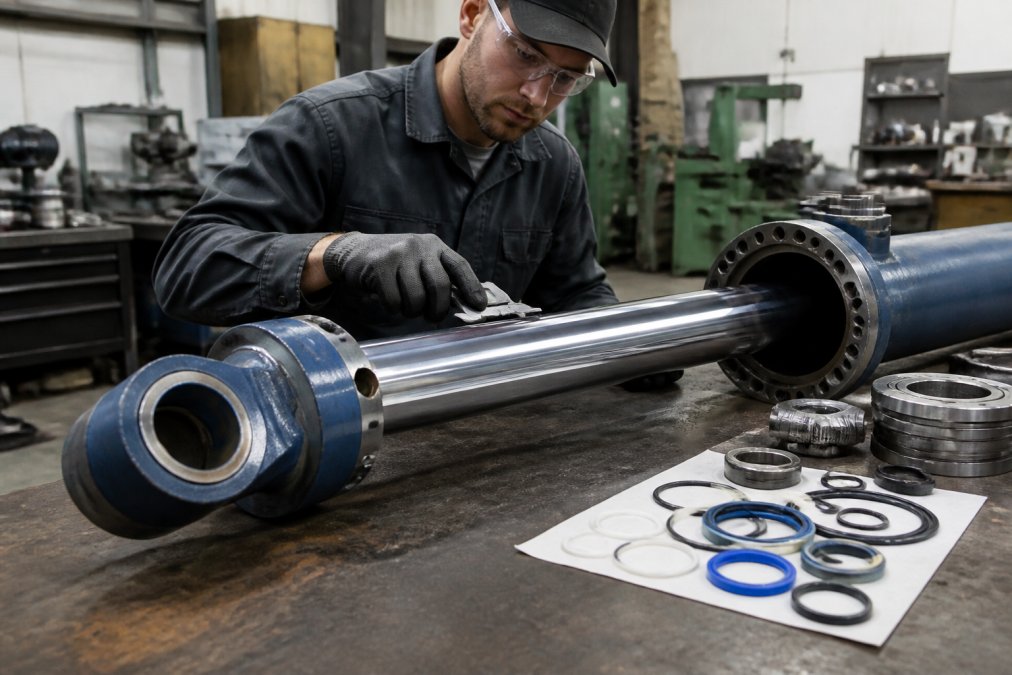
The cylinder is cleaned, documented, and disassembled. Every seal, wear ring, and rod wiper is inspected, and the bore and rod are measured against specification. Leak detection and pressure testing reveal whether the fault is isolated or part of a larger system failure.
Machining, Re-Chroming, and Assembly
Damaged surfaces are repaired. Rod re-chroming restores the hard chrome layer; honing corrects bore scoring; new seals and wear rings are fitted. Assembly is followed by pressure testing before the cylinder ships. This stage is where a shop without in-house machining loses days to outside vendors.
Emergency Hydraulic Cylinder Repair: When Every Hour Counts
Emergency hydraulic cylinder repair is a triage decision, not a full rebuild. When a backhoe, tow truck, or hydraulic breaker is down mid-job, the goal is to get the machine functional safely, then schedule the complete overhaul. Field service can handle seal replacement and leak detection on site, but rod re-chroming and bore machining require a shop.
Hydraulic Cylinder Rebuild Cost vs. Replacement Cost
Hydraulic cylinder rebuild cost is almost always lower than replacement, and the gap widens with cylinder size and age. A rebuild covers parts, labor, machining, and testing. Replacement adds a new or remanufactured unit plus sourcing lead time, which for older equipment can run into months.
How Logistics and Shipping Affect Repair Lead Times
Shipping is the hidden variable in every outsourced repair, and the one most operators underestimate because it does not show up on the repair quote. A cylinder that travels to a national depot crosses multiple hands, and each transfer adds a day.
Why Cylinders Are Expensive and Slow to Ship
A hydraulic cylinder is a dense, awkward, oil-bearing object. A mid-size boom cylinder can weigh several hundred pounds; a large excavator or mining cylinder can exceed a ton. That weight pushes the shipment into freight class territory where you pay by weight, dimensions, and freight class rather than a parcel rate. Cylinders also have to be drained, capped, and often crated or skidded to prevent rod damage in transit, and a bent rod from poor packing turns a five-day repair into a fifteen-day one.
A few practical consequences follow from that:
- LTL freight adds handling. Less-than-truckload shipments get consolidated, transferred between terminals, and re-loaded. Each terminal stop is a day of clock time and a chance for damage.
- Flatbed or dedicated runs are faster but cost more. For a single critical cylinder, a dedicated run can beat LTL by several days, but the premium is real.
- Cross-country transit is the biggest single adder. Coast-to-coast LTL on a heavy skid commonly runs five to seven business days each way, ten to fourteen days of transit wrapped around a repair that might only take five.
- Pickup scheduling is its own delay. Call a carrier Friday afternoon and the pickup may not happen until Monday or Tuesday, before the cylinder moves an inch.
How to Compress the Logistics Side
The repair itself is the shop's problem. The transit is yours, and where you have the most leverage.
- Use a regional shop whenever the repair scope allows. A shop within a one-day drive can often be served by its own pickup and delivery, removing the freight booking step and terminal handling.
- Ask whether the shop runs its own truck. Shops that do can schedule a route pickup within a day or two and control the cylinder from the moment it leaves your yard.
- Ship the cylinder drained, capped, and skidded. A properly prepared cylinder moves faster through freight and is less likely to be re-handled for leaking.
- Consolidate multiple cylinders into one shipment. Three cylinders down across two sites are better served by one coordinated pickup than three separate LTL bookings.
- Pre-stage the paperwork. A bill of lading, repair authorization, and documented fault description traveling with the cylinder prevent the shop from losing a day waiting on clarification.
- Consider a dedicated run for a single critical unit. When the machine is the bottleneck, the freight premium is usually cheaper than another day of downtime.
The Number That Actually Matters
When you compare quotes, compare door-to-door turnaround, not shop turnaround. Ask each shop for the total elapsed time from when the cylinder leaves your yard to when it is back and ready to reinstall. That number folds in pickup scheduling, transit both ways, queue depth, repair time, and return shipping, the only figure your operations team can plan against.
Multi-Site Fleets
If your equipment spans multiple locations, ask whether the shop can coordinate pickups across sites rather than treating each cylinder as a separate shipment. A routed pickup schedule can sweep two or three sites in a single run, cutting freight cost and the time between failure and the shop's queue.
How to Reduce Downtime While Your Cylinder Is Being Repaired
Downtime is not the same as repair time. You can compress the operational impact even when the repair itself takes a week:
- Keep one spare cylinder matched to your most failure-prone machine.
- Schedule preventative maintenance in your slow season, not mid-project.
- Track failure patterns so you replace wear items before they fail.
- Use field service for diagnosis so the shop receives a documented fault, not a mystery.
- Build a maintenance schedule that includes fluid contamination checks.
Frequently Asked Questions
How long does it take to repair a hydraulic cylinder?
Most hydraulic cylinder repairs take 3 to 10 business days once the cylinder is in the shop. Simple seal replacements on common models can be finished in 2 to 4 days. Repairs that need rod re-chroming, custom fabrication, or obsolete parts take longer, often 1 to 3 weeks. Emergency hydraulic cylinder repair services can sometimes compress the timeline to 24 to 72 hours for critical equipment, depending on parts availability and current shop workload.
What factors influence the turnaround time for hydraulic cylinder repairs?
The biggest factors are the type of failure, parts availability, and whether the cylinder needs machining or re-chroming. Internal faults like scored barrels or bent rods add days compared with a standard seal replacement. OEM orders for discontinued components can add 1 to 2 weeks. Shipping time to and from the repair shop also matters, especially for equipment that is hard to move. A shop that manufactures its own parts can often cut turnaround time by several days.
What is the average cost to have a hydraulic cylinder rebuilt?
Hydraulic cylinder rebuild cost varies widely based on cylinder size, damage, and parts. The cost of a hydraulic cylinder rebuild varies widely based on cylinder size, damage, and parts. Emergency hydraulic cylinder repair usually costs more than scheduled work. For an accurate quote, share the cylinder model, photos of the damage, and your timeline with the repair shop.
Is it faster to rebuild a hydraulic cylinder or replace it?
Rebuilding is almost always faster when the cylinder can be repaired locally. New OEM cylinders can take 4 to 12 weeks to arrive, especially for older or specialized equipment. A rebuild typically takes 3 to 10 business days. Replacement makes sense when the barrel is cracked, the cylinder is obsolete and no core is available, or the repair cost approaches 70 percent or more of a new unit. A repair shop can help you compare both options.