 How-to
Sourcing Parts for Vintage Hydraulic Equipment: A Guide
Last Updated: November 5, 2026
Quick Summary
Sourcing parts for vintage hydraulic equipment starts with identifying the nameplate and model number before contacting any supplier. From there, decode legacy part numbers, search surplus and salvage channels, and verify every seller and unit before paying. When the hunt stalls, custom machining or rebuilding the original part is often faster and more certain.
- Photograph the nameplate from two angles and record model, serial, and flow ratings.
- Legacy part numbers often map forward through revisions to parts still in production.
- Search surplus dealers by part number and by machine model, with and without dashes.
- Never install a component rated below the system's relief setting.
- If the machine is critical and down, pay for certainty through custom machining or a rebuild.
Table of Contents
- Start With Identification: The Nameplate and Model Number
- Obsolete Hydraulic Part Sourcing: Reading Legacy Part Numbers
- Searching Surplus, Used, and Salvaged Hydraulic Components
- Custom Hydraulic Parts: When Machining Beats Hunting
- Compatibility and Safe Substitution Checks
- Verifying Suppliers and Spotting Misrepresented Parts
- Comparing Cost, Lead Time, and Risk Across Sourcing Channels
- Get a Quote on Your Hard-to-Find Hydraulic Component
- Frequently Asked Questions
Start With Identification: The Nameplate and Model Number
Sourcing parts for vintage hydraulic equipment starts with one non-negotiable step: identify exactly what you have before you call a single supplier. The nameplate is your ground truth.
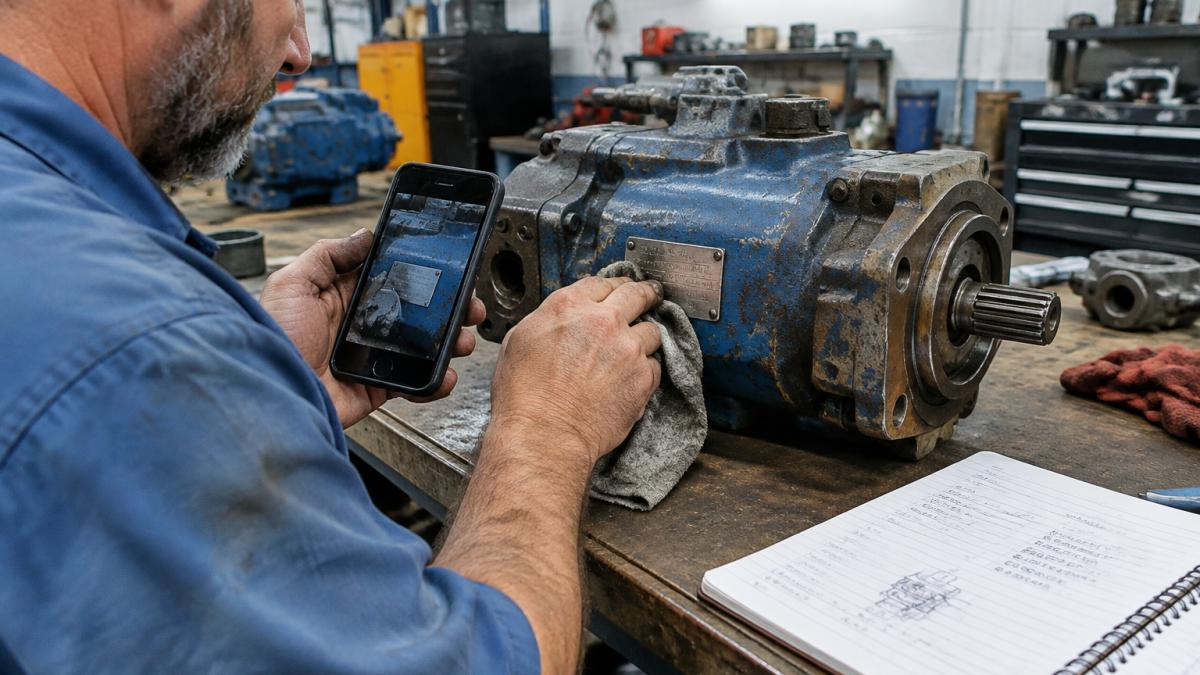
Most failed parts hunts begin with a guess. Someone reads a faded tag from memory, orders what looks right, and the part arrives two weeks later with the wrong bore diameter. Identification isn't paperwork.
Here's what to capture from every nameplate:
- Manufacturer name and any former company names
- Full model number, including suffix codes
- Serial number and build date if stamped
- Flow rating, pressure rating, and displacement
- Any OEM part numbers cast or stamped into the housing
Take clear, well-lit photos of the plate from two angles. Grime hides half the digits on older units, so wipe the surface first and use a flashlight at a low angle to catch the stamping shadows.
Build a Component Photo File Before You Call Anyone
A photo file saves hours of back-and-forth. Photograph the complete assembly from four sides, then the mounting flange, shaft end, port configuration, and any casting numbers. Include a tape measure or ruler in at least one frame so scale is obvious.
Keep the file organized by machine, not by part. When a supplier asks "what does the port look like," you answer in seconds instead of scheduling a second trip to the equipment. This single habit separates a smooth obsolete hydraulic part sourcing project from a frustrating one.
Obsolete Hydraulic Part Sourcing: Reading Legacy Part Numbers
Legacy part numbers follow patterns, and learning to read them is the fastest route to a match.
Break the number into segments and decode each one against the original manufacturer's catalog. Many builders published cross-reference charts that map old codes to current equivalents.
A common mistake is treating a superseded number as a dead end. It usually isn't.
When no chart exists, search the number with and without dashes, spaces, and leading zeros. Suppliers index their catalogs inconsistently, and a number that returns nothing in one format may surface immediately in another.
Searching Surplus, Used, and Salvaged Hydraulic Components
Surplus and salvage channels are where discontinued components actually live. Industrial surplus dealers buy out plant closures and liquidation lots, so a pump pulled from a shuttered line may sit on a shelf for years waiting for your machine.
Search in this order:
- Industrial surplus dealers who specialize in fluid power
- Salvage yards that dismantle heavy equipment
- Online marketplaces with used hydraulic listings
- Owner forums and classifieds for your equipment brand
Search by part number first, then by machine model, then by component description. A vane pump listed only as "hydraulic pump, 30 gpm" will never surface in a part number search, so run both.
What to Inspect on a Used Pump, Motor, or Valve
Used components carry real risk, and the inspection decides whether you bought a part or a paperweight. Ask for photos of the shaft splines, the mounting face, the port threads, and the interior if the unit is opened.
Check for scoring on the shaft, corrosion in the bore, and evidence of heat damage. A used pump with a worn shaft will destroy the seal within weeks. Look at the casting numbers and stamped codes and compare them to your original; a housing that was swapped from a different model may bolt up but flow the wrong direction.
Verifying the Seller and the Part Before You Pay
Counterfeit and misrepresented parts are a real hazard in this market. A component sold as "new old stock" may be a used unit that was cleaned and repainted. A "remanufactured" pump may be a resealed core with worn internals.
Verify these before you pay:
- Business address and phone number, not just a web form
- Return policy in writing, including who pays return freight
- Photos of the specific unit, not stock images
- Casting and stamped numbers matching your original
- A dated note or card in the photo frame so you know the picture is current
- Whether the unit was tested, and on what fluid and pressure
Watch out: a supplier who won't provide detailed photos of the actual unit, only stock images, is hiding something. Ask for the casting numbers, the shaft condition, and a photo of the unit beside a dated note.
For worn or damaged rods, shafts, bushings, pins, and adapters, shaft and hydraulic rod repair in Phoenix, AZ covers the components that most often fail on used assemblies. Photos of real past work tell you more than any sales page, our work gallery shows completed cylinder repairs and machined parts from our shop.
Custom Hydraulic Parts: When Machining Beats Hunting
Machining wins when the hunt stalls.
A machine shop works from your measurements, the original drawing if it survives, or a reverse-engineered sample.
The trade-off is straightforward. Custom work costs more upfront than a lucky salvage find, but it eliminates the uncertainty of a used part with unknown service history.
For hard-to-find or discontinued components, our in-house machine shop handles custom parts in steel, aluminum, and bronze along with repairs.
Compatibility and Safe Substitution Checks
A drop-in replacement is only drop-in when the mechanical and hydraulic details match. Verify all of these before you install anything:
| Check | What to Confirm | Consequence If Wrong |
|---|---|---|
| Mounting | Bolt pattern, pilot diameter, flange type | Won't bolt up, or misaligns |
| Shaft | Diameter, spline count, keyway, length | Coupling failure, vibration |
| Ports | Size, thread type, SAE vs. NPT, position | Leaks, restricted flow |
| Displacement | Flow rating and pressure rating | Wrong speed or overload |
| Rotation | Clockwise or counterclockwise | Immediate internal damage |
| Control | Manual, pilot, solenoid, or proportional | Wrong response, stuck function |
Pressure, Flow, and Displacement
Substituting a higher-pressure-rated unit for a lower one is generally safe. Going the other direction is not. Never install a component rated below the system's relief setting, and confirm rotation direction before startup, because a reversed pump can fail within seconds.
Displacement and flow are not the same number. A pump rated at a given displacement produces different flow at different shaft speeds, so a replacement with the same displacement but a different drive ratio can under- or over-speed the circuit. Match the displacement to the original, then confirm the flow at your actual operating speed.
Rotation, Mounting, and Porting
Rotation direction is stamped on most pumps and motors, and it is the check that fails fastest. A pump built for clockwise rotation run counterclockwise will not build pressure and can damage the shaft seal and internal clearances within seconds.
Mounting is more than bolt count. Pilot diameter and flange type locate the unit; a flange that bolts up but pilots off-center will misalign the coupling and wear the shaft. Port position matters too, a port that points the wrong way can force a hose reroute that restricts flow or chafes against the frame.
Control Type and Safe Substitution
Control compatibility is the check most often skipped. A manual lever valve and a solenoid-operated valve may share the same body and port pattern but respond to completely different signals.
A common pattern is to substitute by pressure rating alone and ignore control type, then discover the function won't modulate. Match the control method first, then the pressure and flow ratings, then the mechanical details.
If the original can be saved, a rebuild is often the safer path. Our hydraulic cylinder rebuild and reseal service covers inspection, new seals, honing, reassembly, and testing.
Verifying Suppliers and Spotting Misrepresented Parts
Counterfeit and misrepresented parts are a real hazard in this market. A component sold as "new old stock" may be a used unit that was cleaned and repainted.
Watch out: a supplier who won't provide detailed photos of the actual unit, only stock images, is hiding something. Ask for the casting numbers, the shaft condition, and a photo of the unit beside a dated note.
Verify these before you pay:
- Business address and phone number, not just a web form
- Return policy in writing
- Photos of the specific unit, not catalog images
- Casting and stamped numbers matching your original
Photos of real past work tell you more than any sales page. Our work gallery shows completed cylinder repairs and machined parts from our shop.
Comparing Cost, Lead Time, and Risk Across Sourcing Channels
Every channel trades cost against speed and certainty. There is no universally best option, only the right fit for your downtime cost.
| Channel | Typical Lead Time | Cost Level | Risk |
|---|---|---|---|
| New old stock | Days to weeks | High | Low if verified |
| Industrial surplus | Days | Moderate | Moderate |
| Used or salvage | Days to weeks | Low | High |
| Custom machining | Weeks | High | Low |
| Rebuild existing | Days to weeks | Moderate | Low |
The decision rule is simple. If the machine is critical and down, pay for certainty through custom machining or a rebuild. If it's a spare for scheduled maintenance, a verified surplus part is a reasonable economy.
Documentation matters here too. Keep every quote, photo, and part number in one file per machine. When the same component fails again in three years, that record turns a week of research into an afternoon.
Get a Quote on Your Hard-to-Find Hydraulic Component
The hardest part of sourcing parts for vintage hydraulic equipment is knowing when to stop searching and start making. Brothers Hydraulics LLC has been committed to delivering high-quality workmanship and custom parts since 2013.
Bring us the nameplate photo, the measurements, and the machine details. We'll tell you honestly whether a rebuild, a substitute, or a custom part is the right call.
You can send photos of your cylinder or part through our quote request page.
Frequently Asked Questions
How do I identify a part for vintage hydraulic equipment?
Start with the machine's nameplate and the component's own tag, then photograph both plus the fitting ports and mounting flange. Write down the model number, serial number, and any cast or stamped numbers on the housing. Measure shaft diameter, port size, and mounting bolt pattern. With that file in hand, a specialty supplier can cross-reference legacy codes or confirm whether a drop-in replacement exists. Clear identification is the single biggest factor in getting the right vintage hydraulic parts on the first order.
Can a custom-machined part replace an obsolete hydraulic component?
Often, yes. When a cylinder, rod, gland, or piston is discontinued, a machine shop can reverse-engineer it from the original and manufacture a replacement to the same dimensions and tolerances. Brothers Hydraulics LLC has built hard-to-find and discontinued components since 2013, . Bring the original part or accurate measurements, and confirm the material and surface finish match the duty cycle before installation.
Are used hydraulic parts safe to install?
They can be, if you inspect before you buy. Check the bore for scoring, the shaft for pitting or a worn chrome layer, and the seals for hardening. Ask for the donor machine's hours and the reason it was dismantled. On pumps and motors, confirm rotation direction and displacement match your spec. A used hydraulic equipment part that passes inspection is a reasonable stopgap, but plan a remanufactured unit or new build for anything on a critical production machine.
What information should I provide when requesting a hydraulic part?
Send the machine make, model, and serial number; the component type (pump, motor, valve, cylinder); every number on the nameplate or casting; photos of all four sides and the ports; and your required in-service date. Note the fluid type and operating pressure if you know them. Suppliers use this to run a cross-reference against legacy codes and to quote accurately. Missing details are the main cause of wrong parts and repeat shipping, so include more than you think is needed.
Your equipment doesn't need to sit idle because a part number went obsolete. Brothers Hydraulics LLC combines over a decade of hydraulic repair experience with in-house precision machining, custom parts manufacturing for hard-to-find and discontinued components, and competitive, fair pricing on every job. Get started with Brothers Hydraulics LLC and get your equipment back to work.